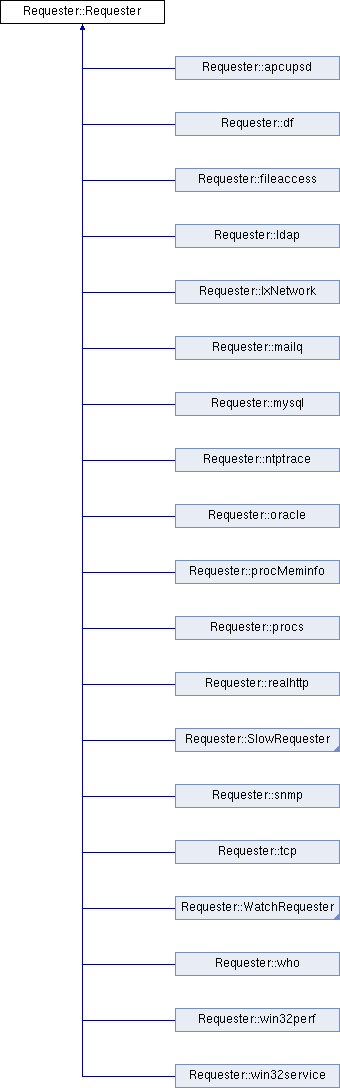
Requesters are responsible for providing the data requested via a "get" statement in tests.cfg (Monitor::Tester). More...
Public Class Methods | |
| new () | |
| create a requester. | |
Public Object Methods | |
| void | register (list domains) |
| Register a requester for one or multiple domains. | |
| hashref | request (hashref env, scalar domain, arrayref variables) |
| Computes (or requests) the values of the variables listed in variables. | |
| boolean | fail_novar (boolean fail) |
| Not used any more? | |
| hashref | getinfo (arrayref gets, arrayref indexes) |
| Called by the default request() method with gets set to the list of the variables, indexes set to the list of variable indexes to be retrieved. | |
| hashref | getwalk (arrayref gets, arrayref indexes, arrayref walks) |
| Similiar to getinfo(), but getwalk() is called by the default request() method if the request includes a "walk" and passes the list of variables to be walked via the walks parameter. | |
| boolean | available (hashref env) |
| Determine if a requester is willing to perform (handle requests) for a given tester environment. | |
| boolean | command_available (list cmd) |
| Tests if cmd is runnable - usually called by classes inherited from Requester::Requester in their available() method in order to find out if a system command they require is present or not. | |
| int | criticalness (int criticalness) |
| Get/Set the criticalness of a handler. | |
| int | consumes (int consumes) |
| Get/set consume level of a handler. | |
Public Functions | |
| list | probe_consumes (hashref env, arrayref variables) |
| Given a list of variable names and an environment, probe_consumes() will try to determine the criticalness/consumes values for the requests that it takes to get all those variable's values. | |
| hashref | get (hashref env, arrayref variables) |
| Given a list of variable names and a tester environment requests all the variables and returns the result in a hash ref. | |
| Requester::Requester | get_handler (scalar domain) |
| Given the name of a domain this function searches for a request handler that is willing to perform requests for this domain. | |
| boolean | load_module (scalar module) |
| Given the name of a module tries to dynamically load Requester::modulename. | |
Protected Functions | |
| protected void | preexit () |
| This function is called during program shutdown. | |
| protected hashref | _get (hashref env, arrayref variables, scalar probe_only) |
| Implements both the get() and probe_consumes() call. | |
| protected void | set_cache (hashref env, scalar domain, scalar name, hashref value) |
| Given a domain, variable name and a value stores the value in the cache under the given domain/name. | |
| protected void | clear_cache () |
| Clear the variable cache. | |
Detailed Description
Requesters are responsible for providing the data requested via a "get" statement in tests.cfg (Monitor::Tester).
Member Function Documentation
| protected hashref Requester::Requester::_get | ( | hashref | env, |
| arrayref | variables, | ||
| scalar | probe_only | ||
| ) |
Implements both the get() and probe_consumes() call.
- Parameters
-
env Tester environment variables List of variable names probe_only If set use probe_consumes() semantics, otherwise get() is performed
- Returns
- Hashref compatible with get() if called with probe_only not set, otherwise a hashref with the keys being the names of domains that need a requester to be called.
| boolean Requester::Requester::available | ( | hashref | env | ) |
Determine if a requester is willing to perform (handle requests) for a given tester environment.
Usually, available() will return false if some required system command is not installed, some API is missing, the test works only against a local machine but the target host is not the local machine, etc.
- Parameters
-
env Tester environment
- Returns
- true if requester is willing to handle requests, false otherwise
| protected void Requester::Requester::clear_cache | ( | ) |
Clear the variable cache.
| boolean Requester::Requester::command_available | ( | list | cmd | ) |
Tests if cmd is runnable - usually called by classes inherited from Requester::Requester in their available() method in order to find out if a system command they require is present or not.
- Note
- The command in question is actually executed via system(), so it is required that the cmd argument includes "save" command line options ensuring that no harm is done to the system and Big Sister.
- Parameters
-
cmd The command to be tested for availability.
| int Requester::Requester::consumes | ( | int | consumes | ) |
Get/set consume level of a handler.
The higher the "consumes" figure is the more other handlers will suffer if running in parallel with this handler.
- Parameters
-
consumes (optional) if defined, set the consumes figure to this value
- Returns
- The current 'consumes' figure.
| int Requester::Requester::criticalness | ( | int | criticalness | ) |
Get/Set the criticalness of a handler.
The higher the criticalness the more the handler will suffer from other handlers to be running in parallel.
- Parameters
-
criticalness (optional) If defined, set the criticalness to this value
- Returns
- The level of criticalness.
| boolean Requester::Requester::fail_novar | ( | boolean | fail | ) |
Not used any more?
- Todo:
- check if fail_novar() is still in use by someone, and if yes, what the hell it is used for
| hashref Requester::Requester::get | ( | hashref | env, |
| arrayref | variables | ||
| ) |
Given a list of variable names and a tester environment requests all the variables and returns the result in a hash ref.
- Parameters
-
env Tester environment variables A list of variable names.
- Returns
- A hash ref.
| Requester::Requester Requester::Requester::get_handler | ( | scalar | domain | ) |
Given the name of a domain this function searches for a request handler that is willing to perform requests for this domain.
If no handler has been registered yet, it tries to dynamically load one via load_module().
- Parameters
-
domain The name of the domain
- Returns
- The handler of the domain or undef if none was found.
| hashref Requester::Requester::getinfo | ( | arrayref | gets, |
| arrayref | indexes | ||
| ) |
Called by the default request() method with gets set to the list of the variables, indexes set to the list of variable indexes to be retrieved.
If gets or indexes are undefined, this means that a 'walk' through all the possible variables has to be performed.
The default behaviour is to call the getwalk() method with an empty walks list. So, a requester implementation has to implement at least one of request(), getinfo() or getwalk() in order to do something useful.
- Parameters
-
gets The list of names of the variables that have to be retrieved. indexes The list of variable indexes that have to be retrieved.
- Returns
- A folded hashref, at the first level the hashref uses the variable index as key, the values each point to a hashref with the name of the respective variable as a key, the scalar value as the value.
Reimplemented in Requester::SlowRequester, and Requester::expedap.
| hashref Requester::Requester::getwalk | ( | arrayref | gets, |
| arrayref | indexes, | ||
| arrayref | walks | ||
| ) |
Similiar to getinfo(), but getwalk() is called by the default request() method if the request includes a "walk" and passes the list of variables to be walked via the walks parameter.
The default behaviour of getwalk() is to just call getinfo() with gets/indexes unset. This has been the default behaviour before getwalk() has been introduced, so getwalk() behaves the same in order to avoid breaking existing requesters. A requester implementation has to implement at least one of request(), getinfo() or getwalk() in order to do something useful.
- Parameters
-
gets The list of names of the variables that have to be retrieved. indexes The list of variable indexes that have to be retrieved. walks The list of variables that have to be "walked"
- Returns
- A folded hashref, at the first level the hashref uses the variable index as key, the values each point to a hashref with the name of the respective variable as a key, the scalar value as the value.
Reimplemented in Requester::expedap.
| boolean Requester::Requester::load_module | ( | scalar | module | ) |
Given the name of a module tries to dynamically load Requester::modulename.
- Parameters
-
module The name of a module
- Returns
- true if successful, false otherwise
| Requester::Requester::new | ( | ) |
create a requester.
Reimplemented in Requester::expedap.
| protected void Requester::Requester::preexit | ( | ) |
This function is called during program shutdown.
| list Requester::Requester::probe_consumes | ( | hashref | env, |
| arrayref | variables | ||
| ) |
Given a list of variable names and an environment, probe_consumes() will try to determine the criticalness/consumes values for the requests that it takes to get all those variable's values.
- Parameters
-
env Tester environment variables A list of variable names.
- Returns
- An array with two values: The first one being the criticalness, the 2nd one the consumer level of the most critical or most consuming requester that has to be called. Returns undef if no requester has to be called at all.
| void Requester::Requester::register | ( | list | domains | ) |
Register a requester for one or multiple domains.
Each Requester has to register itself under a unique domain name. Typically, a requester will create an instance of itself on load (a singleton) and register this instance via register(). This instance will then get "get" requests for the registered domains.
- Parameters
-
domains The list of domain names to register.
| hashref Requester::Requester::request | ( | hashref | env, |
| scalar | domain, | ||
| arrayref | variables | ||
| ) |
Computes (or requests) the values of the variables listed in variables.
The default request() method will process the list of variables and then call getwalk() if the request includes a walk, getinfo() otherwise.
- Parameters
-
env Tester environment domain The name of the domain the request is associated with. If the requester in question is registered for one single domain only, this is always the name of the registered domain. variables List of variable names that are requested. Variable names starting with '@' mean that the requester is supposed to return all variables/values below this prefix.
- Returns
- A hashref containing the variable names associated with their values. Returns 'undef' if the requester cannot perform the request (i.e. because the variable names are unknown or the underlying system failed)
| protected void Requester::Requester::set_cache | ( | hashref | env, |
| scalar | domain, | ||
| scalar | name, | ||
| hashref | value | ||
| ) |
Given a domain, variable name and a value stores the value in the cache under the given domain/name.
- Parameters
-
env Tester environment domain Domain name name Variable name value Value associated with domain/name. The values being stored in the cache are required to be hash references.
The documentation for this class was generated from the following file:
- uxmon/Requester/Requester.pm